

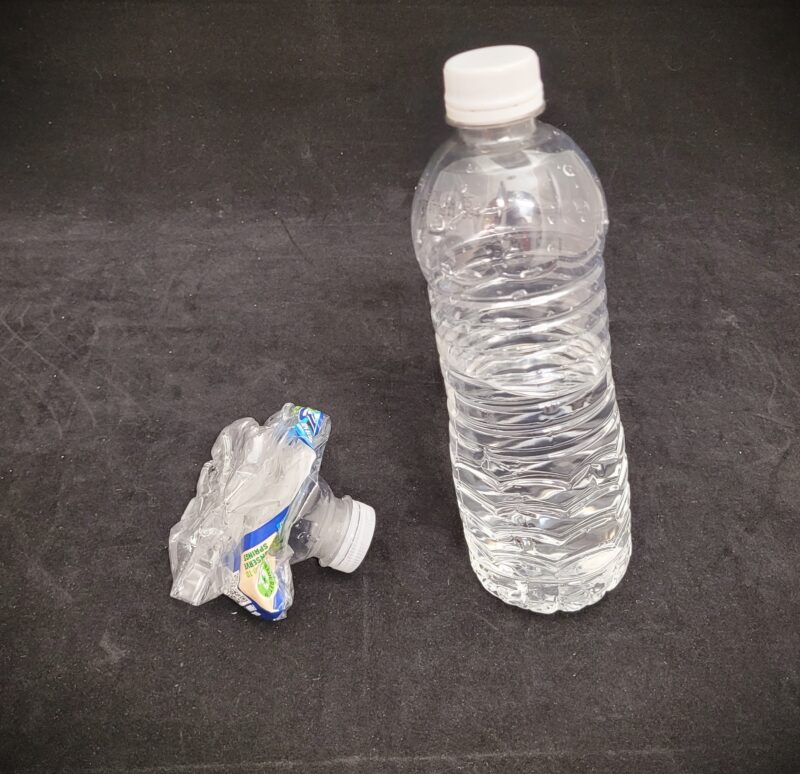
A couple years ago our Co-founder Dennis Salazar asked, Can Sustainability Go Too Far? He cited examples of packaging where this is indeed the case, such as single-use plastic water bottles that have become so flimsy they are practically unusable. It’s a case in which trying to minimize plastic waste creates more problems than it solves. Let’s continue to explore the question Dennis posed.
Welcome to the Protection Business
Most everyone agrees the first job of packaging is protection: if the ceramic vase being shipped arrives in a hundred pieces, the packaging material’s environmental merits won’t matter to anybody.
If protection is packaging’s first priority, a more complicated question is, what is packaging’s second most important priority? Most companies consider that to be cost. But what does “cost” mean?
The Cost(s) of Doing Business
When companies talk about the packaging cost, they usually mean one or more of the following:
- Material cost — The purchase price of the packaging material.
- Cost-in-use — The material cost of the packaging per package shipped.
- Operating cost — The time, space, and human capital required to package each item the company makes or distributes.
- Storage and handling cost — The amount of space and time required to inventory the packaging material. (This can be a significant cost component given the bulkiness of corrugated boxes and many types of inner packing.)
- Carbon footprint — The environmental costs associated with producing, storing, using, shipping, and recycling/disposing of the packaging material.
Companies prioritize and measure these five dimensions of cost differently, but material cost and cost-in-use usually get the most attention. Both are easy to measure and easy to track. Each, in somewhat different ways, represents the bulk of total packaging cost, and each can be trimmed in a variety of ways.
While few would disagree that the carbon footprint of packaging material is a real and important cost, the carbon footprint of packaging is complex and has no universal standard of measurement. Furthermore, the cost of the packaging’s carbon footprint, unlike the other four dimensions, is absorbed by (arguably) everyone on the planet rather than the company itself. Because environmental costs are relatively fuzzy, it’s easy to see how companies can pay little attention to those costs — or too much.
In our experience of nearly 20 years of sustainable packaging design, we have found that companies hyper-focused on material cost are quite tempted to go overboard with sustainability, as demonstrated in the example Dennis used of the flimsy water bottle.
Marketing Can Lead Companies Astray
Marketing-driven companies can also take sustainability too far, because they are focused too much on the customer and not enough (or not at all) on the nitty gritty costs of doing business. Companies looking at their packaging holistically are less likely to make this type of error.
Weigh these marketing questions when deciding whether packaging is “too sustainable.”
- Will the ultra-sustainable package be consistent with the brand and customer expectations?
- Will the ultra-sustainable package “pop” on the retail shelf, or will it fade into the background, conceding market share to the competition?
These issues significantly affect sales revenue and market share. It’s frankly lazy for marketing to assume its target customers value sustainability above all else when proper testing and analysis can confirm it.
Let’s Talk!
Do you want to design greater sustainability into your packaging? This is exactly what we do every day, and we’d love to talk with you about it.
Please call us at 630-551-1700 or contact us through the website to start the conversation.
Related posts:
https://www.salazarpackaging.com/eco-obvious-ecommerce-packaging/
https://www.salazarpackaging.com/eco-friendly-direct-to-consumer-dtc-packaging-made-in-america/
https://www.salazarpackaging.com/sustainable-packaging-and-natural-corrugated-boxes/